

For enterprise sales teams, the old “spray and pray” approach falls short. When a deal is worth six figures and involves a dozen stakeholders, casting a wide net and hoping something sticks wastes time on accounts that were never going to close and leaves your best opportunities under-served.
Account-based sales flips that logic. Instead of chasing as many leads as possible, you focus your effort on a small number of high-value accounts, building strong relationships with several stakeholders inside each one.
In this guide, we’ll explain what account-based sales is, when it’s the right fit and how to build a strategy that turns your highest-value accounts into closed deals.
Account-based sales (ABS) focuses coordinated sales effort on a smaller group of high-value or best-fit accounts.
It involves building relationships with several stakeholders rather than relying on one contact to advance a complex deal.
Account-based sales and account-based marketing are complementary: marketing supports account targeting and engagement while sales manages account-level conversations and opportunities.
The approach is most suitable when deal value, sales-cycle complexity and stakeholder count justify the additional research and coordination.
Pipedrive Nova can support ABS by preparing reps for meetings using their own CRM context and then generate summaries, follow-up actions and suggested CRM updates for review.
What is account-based sales?
Account-based sales is a B2B approach that focuses your sales effort on a small number of high-value accounts, treating each target company as a market of one. Rather than working leads one contact at a time, your team researches each account in depth and builds relationships with several stakeholders across the buying committee.
The idea is simple: fewer accounts, more attention. Instead of measuring success by how many leads you can reach, you measure it by how well you understand and engage the companies that are most likely to become significant, long-term customers.
This makes account-based selling a great tool for managing complex deals, where a single purchase decision involves multiple people, longer timelines and a bigger budget. For those accounts, a coordinated, personalized outreach plan tends to land better than high-volume prospecting.
Account-based sales vs. account-based marketing: what’s the difference?
The terms account-based sales and account-based marketing (ABM) are often used interchangeably, but they describe two different approaches. The simplest way to tell them apart is to remember that ABM is marketing-led while account-based sales is sales-led.
Account-based marketing runs targeted campaigns at a defined set of accounts, warming them up with tailored ads, content and messaging so the right companies arrive already familiar with your brand. Account-based sales picks up from there, with reps engaging individual stakeholders inside those accounts, running conversations and moving specific opportunities toward a close.
They work best together, not as substitutes for each other. Marketing identifies and engages target accounts at scale and sales does the account-by-account execution that turns interest into revenue. Feeding both from the same CRM keeps the relevant account data in front of both teams.
|
Account-based sales |
Account-based marketing (ABM) |
Led by | Sales team | Marketing team |
Main focus | Engaging stakeholders and closing deals within target accounts | Targeting and warming up accounts with campaigns |
Key activities | Multi-threaded outreach, stakeholder conversations and deal progression | Targeted ads, content and personalized campaigns |
Primary goal | Convert target accounts into closed revenue | Generate awareness and engagement in target accounts |
Success measured by | Deals won, account penetration and contract value | Campaign engagement, account reach and marketing-qualified accounts |
Is account-based sales right for your team?
Account-based sales isn’t the right fit for every team. This approach trades volume for depth, meaning it pays off in some sales motions and wastes effort in others. Assess your situation with these four questions to see if ABS is right for your team:
How large is your average deal? The research and coordination that ABS demands make sense when each account is worth enough to justify the investment. For low-value, high-volume sales, traditional prospecting is usually more efficient.
How long is your sales cycle? Longer, more considered buying processes give the account-by-account approach room to work. Very short cycles rarely need this level of coordination.
How many stakeholders shape each decision? If a typical purchase involves one person, single-threaded selling is fine. Once several people are weighing in, engaging them as a group is where account-based sales can make a difference.
What are you selling? Subscription or high-commitment products that lead to long-term relationships are worth the investment. One-time, transactional purchases generally aren’t.
If you answered “large”, “long”, “several” and “ongoing”, account-based sales is likely worth building into your strategy.

How to build an account-based sales strategy
Building an account-based sales strategy means putting the research, targeting and coordination in place before your reps start reaching out. The following six steps give you a clear process to work from.
Start by defining who you're targeting and why, then build out the list, map the people inside each account and get sales and marketing pointed at the same targets. From there, it's a matter of keeping activity on track as deals progress and planning the handoff so nothing gets lost once a deal closes.
Define your ideal customer profile
Start by describing the companies you’re best positioned to serve. A clear ideal customer profile captures the traits your best current customers share, such as industry, size, revenue and the problems they hire you to solve. This becomes the filter for everything that follows.
Select and prioritize target accounts
Use that profile to build a focused list of accounts that are worth the investment, then rank them by fit and potential value. A repeatable account-based sales development process – tiering the list so your highest-priority accounts get the deepest attention – keeps effort proportional to opportunity.
Map stakeholders and relationships
Complex deals always involve several people, so identify the decision-makers, influencers and budget-holders inside each account early. Keeping this contact data organized and in one place means every rep can see who’s involved and how each conversation is progressing.
Coordinate sales and marketing engagement
Account-based sales works best when sales and marketing point at the same accounts with a consistent message. Agree on which accounts you’re pursuing, who owns which touchpoints and how you’ll hand over engagement between teams so nothing falls through the cracks.
Track account activity and next steps
When you have multiple stakeholders and longer timelines, it’s easy to lose track of where each account stands. Log activity consistently and agree on clear next steps after every interaction, so momentum doesn’t stall between touchpoints.
Plan post-sale handoffs and expansion
Closing the deal isn't the finish line. Plan how the account moves from sales to delivery so the context and relationships you've built don't get lost. Use Projects by Pipedrive to keep onboarding and implementation connected to the account after the deal closes, so coordinated account teams can keep working from the same information and you set yourself up for future expansion.
Note: Engaging several stakeholders in one account is often called “multi-threading”. Multi-threading is what keeps a deal alive when a single stakeholder stops responding or moves on.
Metrics to track for account-based sales
Because account-based sales concentrates effort on fewer accounts, the usual volume metrics like lead count tell you very little. Track measures that reflect depth and account progress instead. These four will give you a clear read on whether your account-based sales process is working:
- Average contract value: Since ABS targets higher-value accounts, watch whether your average deal size grows over time. It’s the clearest sign the approach is reaching the right companies.
- Account engagement: Track how many stakeholders you’re reaching within each account and how actively they’re interacting with your team. Broad, active engagement signals a healthy, multi-threaded deal.
- Deal velocity: Measure how quickly accounts move through your pipeline. Well-researched, well-coordinated deals often progress faster despite being larger and more complex.
- Customer lifetime value: Because ABS builds deeper relationships, follow the total value an account delivers over time, not just the first deal. Strong account performance reporting makes these trends easy to see.
Note: Account-based sales works alongside, not instead of, your existing motion. Many teams run it only on their highest-value accounts while sticking to traditional prospecting for the rest.
What to look for in an account-based selling tool
The right software makes account-based selling manageable by keeping account data, stakeholder information and activities in one place. When you evaluate an account-based selling platform, look for these capabilities:
- A single account view: One record that holds every stakeholder, conversation and next step for an account, so everyone on the team works from the same information.
- Multi-stakeholder tracking: The ability to map and follow several contacts per account, not just a single point of contact, so a deal never rests on one relationship.
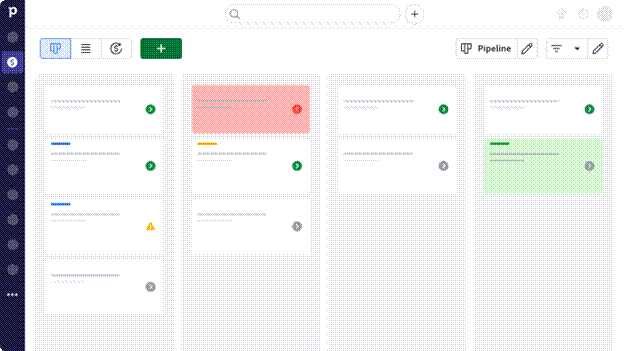
- Clear pipeline visibility: A transparent view of where each high-value account stands, making a complex, multi-threaded motion easier to manage.
- Custom tiers and workflows: Room to set account tiers, tailored pipelines and repeatable processes that fit with how your team actually sells.
- Reporting and integrations: The account-based selling tool should surface account-level metrics and connect with the systems you already use, keeping data flowing without manual entry.
Final thoughts
Account-based sales rewards teams willing to trade volume for depth. By focusing on a smaller set of high-value accounts, engaging every stakeholder who shapes the decision and coordinating closely across sales and marketing, you give your most important deals the attention they need to close – and continue to grow afterward.
Want help preparing for your next multi-stakeholder meeting? Try Nova free and let it turn your CRM context into meeting prep, summaries and suggested follow-up actions.


