Every business occasionally faces problems such as billing errors or service outages. How you respond to those mishaps can make the difference between losing trust and keeping it.
In this guide, you’ll get five apology email templates for common scenarios that you can adapt and send today.
You’ll also find a framework for deciding whether to offer compensation and what to do if the customer still isn’t satisfied.
Key takeaways from apology emails to customers
A specific apology always outperforms a generic one: name the mistake, own it and tell the customer what action you’re taking.
Let the customer’s experience guide whether you offer compensation in your apology email.
For significant mistakes, following up is an important part of the customer apology.
Track apology emails in Pipedrive to spot recurring issues and make sure everyone who needs a follow-up gets one.
What makes a good customer apology email?
A good customer apology email names the mistake, owns it and explains what happens next.
Include these six key elements:
Specific wording. Generic phrases like “we apologize for the inconvenience and appreciate your understanding” can undermine your message. These phrases risk sounding impersonal, or even insincere.
Acknowledgement. Name the mistake clearly. “We shipped your order four days late” lands better than “there was an issue with your shipment”.
Full responsibility. “We got this wrong” reads differently from “there seems to have been a problem on our end”. Passive language reads as deflection. Make it clear that you take responsibility for the mistake.
Corrective actions. Tell the customer what you’re doing to fix the problem or what you’ve already done to address it. “We’ll look into this” isn’t concrete, but “we’ve already issued a refund to your account” is.
Reassurance. “We’ve reviewed our process to make sure this doesn’t happen again” is more meaningful than “we value your business”.
Contact information. Make it easy for the customer to reach your support team directly. The simplest way is to send the email from a real person, which is basic email etiquette that’s easy to overlook.
Before you hit send, put yourself in the customer’s shoes. The email should make the customer feel reassured, not like you’re dismissing their experience.

5 customer apology email templates (by scenario)
Here are five templates for the most common situations SMBs face. Each one works as a template for an apology letter or email.
Delivery delay or missed deadline
A late order or missed deadline leaves the customer in limbo.
Communicate the delay as soon as you can, using this template as a base. That way, you won’t end up having to write a “sorry for the delay in my response” note while the customer is left wondering where their order is.
Subject line: Your order update/We missed our deadline on [project name]
Hi [Customer name],
I’m letting you know that [your order/the project] is running [X days/X weeks] behind schedule.
[Brief explanation without over-explaining: e.g., “We had a supplier issue that affected several orders this week”.]
We expect to [deliver/complete] by [date]. I’ll send you a [tracking link/update] as soon as it’s on its way.
Please accept my sincere apologies for the delay.
Kind regards,
[Your name]
[Company name]
[Contact information]
For longer delays (more than a week), add a line acknowledging the impact: “I know this has affected your timeline, and I’m sorry for that”.
Chewy’s delayed apology email is a great example.

The email names a specific timeframe (“within the next 7-10 days”), tells the customer exactly what happens next (“you’ll automatically receive a tracking link”) and removes any burden from them (“nothing to do on your part”).
The customer finishes reading knowing precisely what to expect, and that clarity is what makes it work so well.
Poor service or product quality issue
When a product or service disappoints, the customer wants to know you’ve looked at their case, not just received a ticket.
Here’s a template apology letter to a client for poor service that feels personal.
Subject line: We didn’t meet the standard we promised you
Hi [Customer name],
Thank you for getting in touch about [briefly describe the issue].
We fell short of the standard we set for ourselves, and I want to express my sincere regret for the negative experience you had. [Describe what went wrong in one sentence, without deflecting.]
I’d like to [replace the product/arrange a call to sort this/issue a partial refund]. Please let me know if that works for you.
Kind regards,
[Your name]
[Company name]
[Contact information]
Real estate tech company Virtual Staging AI’s response to a quality complaint is a good example.

The email is plain text rather than branded and designed. For quality issues, a plain-text email reads as a personal response from a real person rather than a support workflow.
The reply confirms that the refund has already been processed, explains what the team is doing to investigate and offers a discount code at the end. The compensation feels like a genuine gesture and gives the customer an incentive to return.
Note: For service-related apologies, the offer to arrange a call often lands better than a written explanation alone. Speaking directly gives the customer a sense of being heard.
Billing error or overcharge
A billing error shakes trust fast, so answer the customer’s question about when they'll receive a refund before anything else.
This template gives you a good starting point.
Subject line: We’ve refunded your account
Hi [Customer name],
While reviewing your account, I noticed you were [overcharged/charged incorrectly] on [date/invoice number].
The correct amount should have been [correct amount]. I’ve [already issued a full refund/adjusted your next invoice/corrected the charge], and you should see this reflected within [timeframe].
I’m sorry for the confusion this caused. Please get in touch if you have any questions about your account.
Kind regards,
[Your name]
[Company name]
[Contact information]
Mortgage and rental reward platform Bilt’s response to a duplicate charge gets a few things right. It reached out proactively, bolded the refund confirmation so it’s impossible to miss and added a gesture of extra reward points.

One thing that would improve the email is removing the opening paragraph explaining how their payment system works.
The customer doesn’t need context; they need to know what happened and that their money is on its way back.
Miscommunication or wrong information
If a customer acts on wrong information before you catch it, the mistake compounds, so get the correction out quickly.
Use this template to get you started:
Subject line: Correction: [original subject line]
Hi [Customer name],
I need to correct some information I sent earlier.
In my last email, I [e.g., “gave you the wrong pricing for the annual plan”]. The correct information is: [correct details].
I apologize for any confusion this may have caused. Please let me know if you have any questions.
Kind regards,
[Your name]
[Company name]
[Contact information]
For communication mistakes, the subject line does a lot of work. Starting with “Correction:” immediately signals to the customer that there’s updated information and reduces the chance they’ll act on the wrong details.
Incorrect information can also mean customers miss out. Here’s a great example of how dog trainer Suzanne Clothier dealt with a time zone error.

The headline keeps the tone light without dismissing the issue, and the fix is immediately clear.
Download Your Guide to Preventing 5 Common Sales Mistakes
Service outage or technical issues
Downtime blocks customers from doing their work, so the faster you communicate, the less frustration builds.
Subject line: Update on [product/service name]: issue resolved
Hi [Customer name],
We experienced a [service outage/technical issue/system glitch] between [time] and [time] on [date], affecting [describe what was affected].
Our customer service team identified the problem at [time] and worked to resolve it as quickly as possible. We’ve now fixed the issue. [Optional: brief explanation of what caused it, if appropriate to share.]
We understand downtime has a direct impact on your work, and we take that seriously. We’ve put [describe corrective actions: e.g., “additional monitoring in place”] to prevent a recurrence.
If you experienced any data loss or need support from our team as a result of this outage, please contact us directly at [contact information].
Our sincerest apologies for the disruption.
Kind regards,
[Your name]
[Company name]
For service outages affecting a large number of customers, consider sending a proactive communication before customers reach out. A delayed response to a known outage damages customer satisfaction far more than the outage itself.
Algolia, a search and indexing API, sets the benchmark here. Its outage email is highly specific: eight minutes of downtime, the exact time it started and which operations were affected and which weren’t.

It links to a full postmortem on the blog for customers who want the technical details, providing transparency without making the email too long.
The email comes from a named person rather than a generic support address, which makes it feel like an individual taking responsibility rather than a company issuing a statement.
When should you offer compensation in the email?
The impact of your mistake on the customer is a good guiding principle for when to offer compensation.
For example, sending an email with the wrong pricing information might be slightly annoying, but the impact stops there. A sincere apology is enough.
Compare that to a service outage that takes a customer’s platform offline for several hours during a product launch. The mistake has a direct knock-on effect on their work and potentially their revenue. That warrants more than an apology.
Use this table as a quick decision framework to decide whether compensation is the right move.
Situation | Appropriate remedy |
Minor delay, quickly resolved (e.g., a delivery that arrived one day late) | Apologize and give a proactive update |
Significant delay or missed deadline (e.g., an order that caused a customer to miss a launch) | Offer a discount or coupon on the next purchase |
Defective product or failed service (e.g., a product that arrived damaged or a service the company didn’t deliver) | Offer a replacement or full refund |
Billing error (e.g., a duplicate charge or incorrect invoice) | Immediately correct the error and refund the overcharge |
Service outage with business impact (e.g., a platform that went down during a customer’s peak trading hours) | Apply a service credit to the next order |
Repeated failures on the same account (e.g., a customer who has contacted support three times about the same issue) | Process a partial refund and have a senior team member call the customer directly |
When you include compensation, place it toward the end of the email, after the apology and the fix. An offer that opens the email might read as if you’re trying to sidestep the genuine apology.
How to follow up after a customer apology email
Most apology emails don’t need a follow-up, but for significant mistakes, checking in can rebuild trust or even prevent customer churn.
For example, say a SaaS scheduling company had a technical error that prevented its clients’ customers from booking demos for several days. This type of mistake results in lost revenue that the customer might not be able to recover.
Wait two to three business days, then send a short follow-up email to make sure the customer is satisfied with the resolution. Keep it brief:
Subject line: Following up on [issue]
Hi [Customer name],
I wanted to make sure you received my message about [issue] and that everything is on track. Please let me know if there’s anything else I can do.
Kind regards,
[Your name]
[Company name]
[Contact information]
If the customer pushes back or is still unhappy after your apology, don’t send another template. Call them. Written apologies have limits, and angry customers usually just want to feel heard.
Keep in mind that unresolved customer complaints occasionally surface on social media. Fast, genuine follow-through is your best protection from bad customer feedback.
How to use Pipedrive to track and follow up on apology emails
When a mistake affects multiple customers, keeping track of individual communications ensures everyone gets the attention they deserve.
In Pipedrive, your customer service team and sales team members can add labels to contact records to find them more easily. For example, you might add a “March billing error” label to a group of affected customers.

Adding a label to each contact lets the whole team filter to exactly those customers and work through them as a group, rather than trying to identify who was affected from memory.
From there, you can use Campaigns by Pipedrive to send an apology email directly to that labeled group, following email marketing best practices.

Use merge fields to automatically pull in each customer’s name and relevant account details, so the email feels personal even when you’re sending it to a large number of people at once.
For cases that need individual follow-up, log each complaint as an activity on the contact record and set an activity reminder email so you don’t miss anyone.
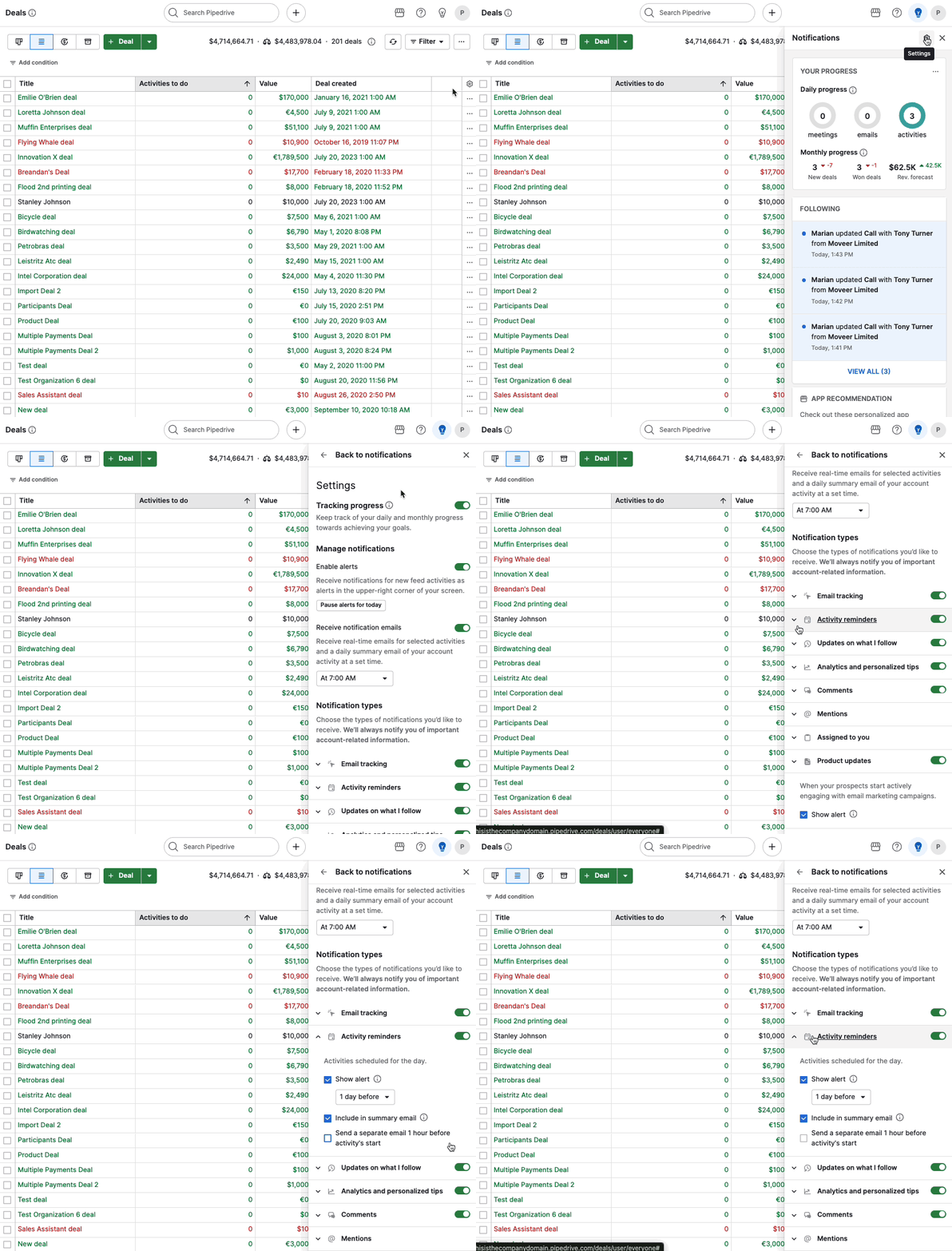
By labeling your contact, over time, you’ll have a clear picture of where issues are clustering. Fix the root cause, and you reduce the number of apology emails you need to send and improve your customer relationships.
Final thoughts
Whatever kind of customer apology email you‘re sending out, focus on these main points to achieve customer success:
Be sincere when apologizing
Own the mistake
Explain in detail why you are apologizing
Show that you understand the customer’s goals and views
Have a plan of action to solve the problem
Ask for customer feedback when possible
Wondering what to say at the end of an email apologizing to the recipient? It depends. As you can see in the templates above, it’s often worth taking the opportunity to invite further engagement to keep them talking.
If you follow these simple “how to apologize in an email” guidelines, your apology email will sound more sincere and will help you to rectify the situation with the customers that you wronged.
If you liked this article (and each template of a short apology message to customers included) be sure to check out our email marketing best practices.