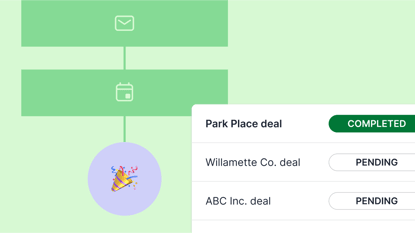
Customer acquisition solutions built for real sales workflows

Customer acquisition solutions

Customer acquisition solutions help SMB teams turn lead generation into measurable pipeline and revenue.

The right system replaces the guesswork of not knowing which efforts are actually driving new business. It ties every stage of the customer journey, from first touch to pipeline to closed deals.

In this article, you’ll learn the best options for SMB and small business teams, how to choose one based on your sales model and what to track so your acquisition efforts show up consistently.


Key takeaways from customer acquisition solutions

  • Customer acquisition solutions are tools and services that connect acquisition activity to sales execution and revenue.

  • The biggest benefit is clearer visibility into what drives pipeline and revenue, not just lead volume.

  • The main tradeoff occurs when solutions add reporting without improving follow-up, ownership or conversion.

  • Sign up for a free 14-day trial to see how Pipedrive links acquisition efforts directly to pipeline activity and closed deals.


Why teams look for customer acquisition solutions

Customer acquisition solutions are the tools, systems and services that help teams attract, qualify and convert potential customers into new, paying customers – while also improving retention and customer loyalty among existing users.

Teams start looking for them when spend rises and sales activity looks healthy, but it’s unclear which efforts are actually driving new business.

Several factors feed into that pressure to adopt a clear customer acquisition process.

Rising costs make visibility non-negotiable

Customer acquisition costs (CAC) for growth-stage B2B companies jumped 40–60% between 2023 and 2025, driven by stricter privacy rules, increased competition and breakdowns in attribution across multi-touch journeys.

Bottom-quartile SaaS companies now spend $2.82 in sales and marketing to acquire just $1 of new annual revenue.

CAC also varies sharply by industry and customer type. Business services teams might see an average of $585, while construction sits closer to $610 and project management climbs to $891.

These benchmarks show how quickly acquisition costs can erode margins if conversion rates weaken, sales cycles lengthen or customer churn increases.

When costs rise this sharply, visibility into which customer acquisition channels and campaigns are generating a qualified pipeline shifts from a nice-to-have to essential.

The real breakdown happens after leads come in

Misaligned KPIs between marketing and sales cause nearly half of all leads to get dismissed as low-quality before anyone properly works them, even when many could be high-quality opportunities.

Meanwhile, teams measure activity such as calls made, meetings booked and forms filled instead of outcomes like pipeline creation, revenue contribution and customer retention. Most acquisition strategies fail at precisely that point.

Generating interest is valuable only when that interest flows into a structured sales process that helps qualify opportunities and close deals. Customer acquisition solutions help bridge the gap.

Types of customer acquisition solutions

Most customer acquisition solutions fall into a few main categories.

Solution type

Description

Software-based

What it is: Customer acquisition software that creates structure and visibility across the acquisition workflow.

When to use it: When you need repeatable processes, clear ownership and a way to connect lead source to pipeline and revenue.

Examples: Customer relationship management (CRM), lead capture tools and reporting platforms.

Service-led

What it is: Agencies or outsourced teams that execute parts of customer acquisition on your behalf, such as demand generation or outbound outreach.

When to use it: When you lack in-house capacity or need short-term execution support to launch or scale campaigns.

Examples: Customer acquisition companies, specialized agencies and outsourced outbound teams.

Inbound and outbound approach

What it is: Inbound attracts customers through digital marketing channels including content, SEO, social media and paid media, while outbound relies on proactive sales outreach such as email and calling.

When to use it: Based on sales model, deal size and available resources. Most teams use a mix.

Examples: SEO, content marketing, email marketing, paid advertising, LinkedIn outreach, targeted messaging, cold email, paid ads and calls.

Hybrid acquisition setup

What it is: A combination of software, services, marketing strategy and multiple channels working together in a single acquisition system.

When to use it: When you need to scale acquisition without losing control or visibility into follow-through.

Examples: CRM plus services and inbound and outbound channels.


Most teams use multiple channels and systems together rather than relying on a single approach.

For example, RevenueCat’s success story shows how a hybrid B2B customer acquisition strategy paired targeted content with automated routing, resulting in a 30% increase in demo requests and a 75% lift in conversion rates from priority accounts.

The tools below help make that combination work in practice.


7 best customer acquisition solutions for SMBs

Below is a snapshot of customer acquisition solutions SMB teams use to move from lead generation to revenue.

  1. Pipedrive – a CRM that connects acquisition activity directly to pipeline visibility and closed deals

  2. Leadfeeder – Identifies high-intent website visitors and feeds warm leads into sales workflows

  3. Zapier – Automates data flow between acquisition tools to reduce manual handoffs

  4. Plecto – Visualizes acquisition and sales performance with real-time dashboards

  5. Livestorm – Captures and qualifies demand through webinars and live events

  6. JustCall – Enables outbound calling and follow-up at scale with AI-powered assistance

  7. PartnerStack – Helps SMBs acquire customers through affiliates and partners

Note: Interested in earning by promoting tools you trust? Apply to become a Pipedrive Affiliate and receive a generous recurring revenue share.


Let’s take a closer look at how each one fits into an SMB acquisition stack.


1. Pipedrive

Pipedrive is a sales-first CRM that connects lead capture, follow-up and pipeline visibility in one place.

Customer acquisition solutions Pipedrive dashboard


Pipedrive serves SMB and mid-market teams that want acquisition efforts to flow directly into a

structured sales process, not just lead lists that sit in spreadsheets.

What it’s best known for

Pipedrive is built around daily use, not a one-time setup. Teams rely on it to keep deals moving because the interface stays simple even as volume grows. One G2 reviewer captured this by saying, “It is a daily tool for me that has become part of my necessity to function.”

Where it fits in a customer acquisition workflow

While most acquisition breaks in predictable places, Pipedrive qualifies as a customer acquisition solution because it connects the full loop throughout the customer journey by:

Tying activity back to pipeline movement, closed deals and customer success milestones

Pipedrive in action: Tiffany Largie used Pipedrive to manage data for 30 door-to-door sales reps generating up to 300 outreaches a day. The business scaled to over $2 million in sales as a result. After selling the company, Tiffany helped an accounting firm uncover $188K in revenue by systematically working through its pipeline inside Pipedrive.


Pipedrive features that support customer acquisition

1. LeadBooster to capture leads

Customer acquisition solutions Pipedrive LeadBooster inbox


When interest is coming in but not entering a structured system, LeadBooster bridges the gap. It covers web forms, landing pages, chat, visitor tracking and prospecting, so leads flow directly into the CRM instead of getting stuck in inboxes or spreadsheets.

2. Pipeline View + Sales Automation

Customer acquisition solutions Pipedrive automation


Pipedrive’s pipeline view makes next actions obvious. Teams can add activities, set ownership per deal and automate reminders with Pipedrive’s sales automation features.

Another reviewer summed up the value of this layer saying: “My favorite feature is all the automations. No more having to set reminders […] Just put them in a deal and let Pipedrive do the work.”

3. AI-powered prioritization

Customer acquisition solutions Pipedrive Notifications


Pipedrive Notifications helps reps focus on deals most likely to move by surfacing insights based on pipeline activity, stage progression and engagement patterns. This reduces time spent sorting through low-intent opportunities and keeps attention on high-value conversations.

When SMB teams use Pipedrive consistently, fewer leads leak, follow-through improves and customer experience strengthens.


2. Leadfeeder

Leadfeeder is a website visitor identification tool that reveals which companies are visiting your site even if they never fill out a form.

Customer acquisition solutions Leadfeeder dashboard


It serves teams that generate website traffic but struggle to identify which companies are actively researching them.

What it’s best known for

Leadfeeder turns anonymous website traffic into identifiable potential customers at the company level, helping teams focus on the right prospects. Instead of seeing “500 visitors”, teams see which organizations visited, how often and which pages they viewed.

One reviewer noted that the setup process “took just five to ten minutes to complete”, reinforcing its positioning as a lightweight add-on rather than a heavy system overhaul.

Where it fits in a customer acquisition workflow

Leadfeeder strengthens the top of the acquisition funnel by identifying hidden demand from visitors who land on your site or landing pages.

It surfaces visiting companies and lead qualification signals and qualifies them based on behavior at this early touchpoint. Later, it syncs that data directly into your CRM to create or enrich deals. This makes outbound warmer and follow-up more intentional.

Leadfeeder features that support customer acquisition

Feature

What it does

Company-level visitor identification

Identifies companies visiting your website and shows page-level engagement to help prioritize accounts based on interest signals.

CRM syncing and workflow integration

Pushes visit data directly into your CRM, where sales teams can create deals, assign ownership and trigger follow-ups.


Leadfeeder works best when paired with a structured CRM process that connects intent data to pipeline movement and follow-through.


3. Zapier

Zapier is a no-code automation platform that connects marketing, CRM, sales and support tools so data moves automatically between them.

Customer acquisition solutions Zapier workflow


The platform serves SMB and mid-market teams that want their acquisition stack to work together instead of operating in silos.

What it’s best known for

Zapier connects over 8,000 apps without requiring code. Growing teams don’t need engineering support to connect form submissions to CRM deals, email marketing workflows or demo requests to rep notifications.

Where it fits in a customer acquisition workflow

Zapier ensures demand doesn’t stall after it’s generated. Without automation, the chain often breaks between “form submission” and “rep action”. Zapier reduces that gap by routing leads, creating or updating CRM deals and triggering follow-ups immediately.

As Gerardo P., CEO and G2 reviewer, put it: “Zapier acts as the central engine that connects our CRM (Pipedrive), marketing tools, lead generation systems and internal workflows.”

Zapier features that support customer acquisition

Feature

What it does

Multi-step workflows (Zaps)

Allows teams to create automations where one trigger leads to several actions.

CRM integrations (including Pipedrive)

Automatically creates new deals, updates records and triggers follow-ups without manual data entry.

Conditional routing and lead logic

Routes leads based on criteria like deal size, intent or account type.


As workflows become more complex, Zapier setup requires thoughtful configuration and pricing scales with task volume.


4. Plecto

Plecto is a real-time KPI dashboard and performance reporting platform built to help revenue teams track metrics that influence pipeline and revenue.

Customer acquisition solutions Plecto dashboard


It supports teams that want acquisition activity to be measurable, visible and tied to specific targets, not just recorded inside a CRM.

What it’s best known for

Plecto turns raw CRM and sales data into live dashboards that enable data-driven decisions teams can act on.

Instead of waiting for end-of-month reports, managers can track conversion rates by stage, revenue growth trends, activity levels per rep and follow-up consistency in real time.

Where it fits in a customer acquisition workflow

Plecto strengthens what happens after leads enter your system.

In most teams, acquisition breaks not because demand is low, but because execution is inconsistent – follow-ups slow down, activities drop mid-month and conversion rates aren’t reviewed until it’s too late. Plecto makes leading and lagging indicators visible in real time.

Plecto features that support customer acquisition execution

Feature

What it does

Real-time KPI dashboards

Monitors daily activity against targets, stage-by-stage conversion and revenue progress to help teams correct performance mid-cycle.

Gamification and coaching tools

Reinforces speed-to-lead discipline, consistent follow-up activity and focus on qualified pipeline through contests and achievement tracking.

CRM and automation integrations

Reflects real pipeline activity from connected systems to reinforce accountability across marketing and sales.


Plecto’s setup requires thoughtful configuration, especially for custom KPIs, but this flexibility benefits teams that want deeper control over performance tracking.


5. Livestorm

Livestorm is a browser-based webinar platform that helps teams turn early interest into sales-ready intent through demos, trainings and virtual events that connect directly to their CRM.

Customer acquisition solutions Livestorm webinar


It serves marketing and revenue teams that rely on live interaction to qualify prospects and position webinars as a structured mid-funnel conversion step.

What it’s best known for

Livestorm’s browser-based webinars help teams engage their target audience, identify ideal customers and qualify potential customers through live, on-demand and automated event formats.

Because events run entirely in the browser, friction for attendance is lower. As one reviewer on their pricing page states: “Engagement on Livestorm is great: our 45-minute event ended up going past the 60-minute mark because the questions just kept coming!”

Where it fits in a customer acquisition workflow

Livestorm works best after initial awareness is created through digital marketing efforts such as content marketing, social media campaigns, paid ads or outbound outreach.

Webinars act as a filter and allow teams to test buyer personas, address pain points, answer questions, qualify intent and refine messaging based on audience engagement. These registrations indicate curiosity, attendance indicates intent and engagement signals (poll responses, Q&A participation, demo viewing) indicate readiness.

Livestorm integrates with CRMs and marketing platforms, so registration and attendance data can automatically trigger follow-up actions.

Livestorm features that support customer acquisition

Feature

What it does

Browser-based access

Reduces technical drop-off and improves attendance rates by eliminating software installation requirements.

CRM and marketing integrations

Automatically creates or updates contacts, syncs event engagement and triggers follow-ups based on behavior.

Engagement tracking and analytics

Captures polls, Q&A, chat interactions and attendance duration to help distinguish passive viewers from active buyers.


Livestorm provides the infrastructure, but conversion impact depends on how intentionally teams use it within their broader acquisition system.


6. JustCall

JustCall is a cloud-based sales communication platform that helps revenue teams move faster after a lead enters the system through AI-powered calling, SMS automation and real-time CRM syncing.

Customer acquisition solutions JustCall dialer


It suits teams that want speed, structure and consistency in their follow-up process.

What it’s best known for

JustCall is known for AI-powered sales dialers, automated SMS and follow-up workflows, real-time CRM syncing and call tracking with summaries and performance insights.

Instead of reps juggling spreadsheets, manual dialing and disconnected tools, JustCall centralizes outbound execution in one workflow.

Where it fits in a customer acquisition workflow

Many acquisition strategies focus heavily on generating leads and identifying the right prospects, but leads enter through different channels such as forms, ads, referrals, partner networks or outbound prospecting.

At this stage, response speed is often the true conversion lever. If follow-up is slow or inconsistent, interest fades quickly.

JustCall addresses that need by enabling teams to:

  • Auto-dial new leads instantly

  • Respond quickly

  • Identify pain points during calls

  • Route calls intelligently

  • Send follow-up SMS automatically

  • Log conversations directly in the CRM

Since communication activity syncs with CRM systems, sales teams can see exactly which conversations move deals forward.

JustCall features that support customer acquisition

Feature

What it does

AI-powered dialer and outbound automation

Browser-based calling with automatic logging, call summaries and triggered follow-ups based on outcomes.

SMS and multichannel follow-up

Automates SMS follow-ups across channels with conversations attached to contact records.

CRM syncing and performance visibility

Automatically updates calls, notes and outcomes in CRM to track activity volume and conversion rates.


JustCall pricing scales with usage and call volume and teams focused on new business development need defined processes in place to fully benefit from automation.


7. PartnerStack

PartnerStack is a partner ecosystem platform built for B2B SaaS companies that want to grow through affiliates, resellers, agencies and co-sell partnerships, not just paid channels.

Customer acquisition solutions PartnerStack dashboard


It helps teams recruit partners, track partner-sourced revenue and automate commissions within a single, structured system.

What it’s best known for

Teams use PartnerStack to launch affiliate and reseller programs, leverage social media partnerships, track partner-sourced revenue, automate commission calculations and discover new partners through its B2B marketplace.

PartnerStack is built for structured ecosystem programs that scale beyond one-off referrals.

Where it fits in a customer acquisition workflow

PartnerStack is unlike lightweight affiliate tools focused only on referrals or acquisition channels that rely on paid advertising spend. Partnerships shift the model by incentivizing partners to expand their customer base by identifying, engaging and promoting products to new and potential customers, rather than paying for impressions or clicks.

PartnerStack works best when product-market fit is established and teams want to diversify beyond paid acquisition. According to a GTM Partners ROI study, companies report 33% faster payback compared to the average PRM, improving capital efficiency and reducing pressure on short-term CAC recovery.

PartnerStack features that support customer acquisition

Feature

What it does

Partner recruitment and marketplace

Helps teams discover and recruit affiliates, resellers and agencies through a B2B partner marketplace.

Revenue tracking and attribution

Tracks partner-sourced revenue and attributes deals to specific partners for visibility into channel performance.

Automated commission payouts

Calculates and automates commission payments to reduce manual overhead and improve partner trust.


For SaaS teams ready to scale through ecosystem growth, PartnerStack provides a structured way to turn partnerships into a predictable acquisition channel.


How to choose the right customer acquisition solution

Choosing a customer acquisition solution is about aligning your acquisition system and marketing strategy with how your target audience buys and how revenue actually happens in your business.

For many SMB-focused B2B companies, acquisition cost sits in the mid-hundreds. In SaaS-heavy categories, it can range from $600–$900 depending on the industry.

Since CAC benchmarks vary widely by industry and buyer type, the question becomes less about which tool and more about whether your current system matches your team’s complexity.

Choosing based on company size and growth stage

Acquisition systems should evolve as your team grows because the risks, costs and coordination challenges change at each stage.

1. Early-stage teams

In very small teams, often fewer than 10 people across sales and marketing, the biggest constraint for small businesses is clarity as leads getting lost in inboxes or spreadsheets creates the primary risk.

A simple CRM that centralizes lead capture and ownership is usually the better starting point for building a customer base.

2. Growing teams

As teams expand into the 10–40 range, acquisition starts to feel expensive. Industry benchmarks show acquisition costs rising across many B2B segments.

When CAC lives in the hundreds of dollars, even small tracking leaks become costly.

At this stage, teams need clear routing rules, shared KPIs, performance dashboards and automated follow-ups. The focus shifts from generating more leads to improving conversion per lead.

3. Mid-market teams

Once revenue teams move beyond roughly 40 contributors, coordination and competition become dominant pressures.

Acquisition costs have risen 40–60% in recent years across growth-stage B2B teams, which changes the decision criteria.

Mid-market teams should evaluate payback period, partner-led channels, automation leverage and reporting depth. Hybrid models that combine CRM, referral programs, automation, outbound, webinars and partnerships often outperform single-channel strategies.

Choosing based on sales model and motion

Understanding buyer personas and how different customer segments buy is foundational to choosing the right acquisition approach.

Revenue mechanics should dictate your acquisition system because the way money moves through your company determines what actually creates leverage. For instance:

Sales motion

How revenue closes and what to prioritize

Sales-led B2B

What drives conversion: Speed-to-lead and consistent follow-up from reps.

System priority: Lead routing, CRM visibility, social media engagement tracking, call velocity and activity tracking that support disciplined execution.

Product-led growth (PLG)

What drives conversion: Product activation and meaningful usage after signup.

System priority: Behavior tracking, activation metrics, lifecycle automation, retention triggers and clear free-to-paid triggers that convert users into paying customers.

High-ticket and enterprise

What drives conversion: Precision, trust, understanding buyer pain points and structured deal progression over time.

System priority: Ideal customer targeting, account-based marketing, tailored messaging, customer success alignment, partner channels and well-defined pipelines that support complex sales cycles.

Transactional and SMB

What drives conversion: Fast response times and frictionless buying experiences.

System priority: Automation, streamlined workflows, customer experience optimization and conversion rate optimization to keep CAC efficient.


Different sales models require different acquisition systems. Sales-led teams need speed and follow-up discipline, while product-led teams need activation tracking and behavioral triggers.

Choosing based on cost vs. value

The right acquisition solution improves conversion consistency, builds customer loyalty, reduces churn and shortens payback time, not just upfront cost.

Payback period (the time it takes to recover what you spent acquiring a customer) matters more than cost per lead because cheap leads that don’t convert can quietly increase downstream sales costs.

Lower-cost channels may look efficient when they generate traffic, but if leads aren’t qualified, routed properly or followed up quickly, conversion rates drop and payback stretches.

Consider how the solution aligns with your buyer personas and purchase journey. Before committing to a solution, evaluate whether it:

  • Reduces leakage. Look for solutions that improve response time, conversion consistency and high-quality lead routing through automated routing, clear ownership and follow-up reminders.

  • Ensures adoption. Choose tools teams will actually use. A clear CRM strategy keeps processes simple and reduces friction from heavy training. Adoption matters more than features.

  • Tracks payback period. Payback period shows how quickly you recover acquisition cost. Solutions that provide visibility into this metric help you optimize spend and improve payback timing.

  • Scales without increasing admin burden. Tools should save time as volume grows, not create chaos. Automation and streamlined workflows keep acquisition scalable.

  • Clarifies stage progression and revenue contribution. Solutions that connect lead source to deal stage to closed revenue eliminate attribution guesswork and align marketing and sales on what “qualified” means.

A solution is justified when it improves conversion consistency and payback speed, not simply when it lowers upfront cost. To understand why these factors matter, you have to look at what happens after a lead enters the system.


How to measure acquisition performance and connect it to revenue

Customer acquisition produces business value only when it generates qualified pipeline and closed revenue. The connection between acquisition and revenue depends on tracking the right metrics and building data-driven systems that ensure acquisition data flows into sales execution.

Most SMBs and small businesses already have the tools they need to measure their customer acquisition process. If your CRM captures lead source, tracks stage progression and records revenue on closed deals, you have the foundation for practical reporting.

Key metrics to track

Focus on what links acquisition activity to revenue outcomes and customer lifetime value. These metrics also influence customer retention by helping teams focus on high-value relationships.

1. Customer acquisition cost (CAC)

This measures how much you spend to acquire one paying customer and should define what “acquisition spend” includes upfront to ensure consistency.

2. Conversion rate by stage

Track conversion at each stage (lead to qualified, qualified to opportunity and opportunity to closed). Leakage between stages is where revenue potential disappears, but a simple conversion funnel makes this easier to spot.

3. Payback period

The payback period shows how quickly you recover the acquisition cost. It helps teams balance investment between acquiring new customers and retaining existing customers, as well as predict customer lifetime value to plan investments better. If you can’t measure this, you can’t optimize it.

4. Pipeline contribution by source

Connect lead source to deal stage and closed revenue inside your CRM, using consistent lead reporting to map the customer journey across every touchpoint. Clarify which customer acquisition channels and email marketing campaigns generate qualified opportunities.

Here’s how to calculate CAC and payback period:

Metric

How to calculate it

Total acquisition spend

Ad spend + salaries + tools for the period

CAC

Total spend ÷ new customers

Payback period (months)

CAC ÷ monthly revenue per customer


For example, if a team spends $30,000 in one month and closes 40 new customers, CAC is $750. If each customer generates $250 per month, payback occurs in three months.

Setting up simple analytics without a data team

To measure acquisition without the need for technical input, start with the fundamentals below.

1. Centralize lead capture

Every form, webinar registration or chatbot inquiry should route into your CRM. Parallel spreadsheets create blind spots.

2. Assign ownership from the start

Each deal should have a clear owner and defined next action. Without this, leads sit unworked.

3. Define stage criteria before disputes arise

Stage movement should reflect agreed qualification standards. When marketing and sales use different definitions of “qualified”, sales teams dismiss up to 45% of leads as low quality before proper follow-up.

4. Build baseline visibility

A simple dashboard showing leads by source, deals by stage and revenue closed per period surfaces actionable insight.

From that structure, you can generate revenue by source, conversion rate by stage, email marketing performance, sales cycle length and pipeline value by channel.

Common mistakes to avoid

Acquisition implementation typically fails after leads enter the system rather than before. Common patterns include:

  • Leads arriving without clear ownership. Automatic routing to a named rep prevents opportunities from going cold.

  • Metrics focusing on activity rather than outcomes. Track pipeline created, email marketing performance and revenue contribution, not just meetings booked or traffic volume.

  • Disconnected tools. When CRM, ad platforms and reporting systems operate independently, attribution becomes guesswork. Centralize data in one system.

Focus on consistent ownership, measurable stage progression and clear visibility from lead source to closed revenue.

Customer acquisition solutions FAQs


Final thoughts

The gap between acquisition spend and revenue clarity closes when lead source, pipeline stage and closed deal connect in one customer acquisition solution where execution is visible and accountable.

That visibility changes priorities. Teams shift from measuring activity to gauging progression, from tracking volume to calculating conversion and from hoping follow-up happened to knowing it did.

For SMB teams ready to move from scattered execution to structured growth, Pipedrive provides the CRM foundation that turns acquisition activity into visible pipeline and closed revenue. Start your free trial to see how it works for your team.

Driving business growth

Driving business growth